
 |
||
B. Craig Owens |
||
Senior Vice President —
|
Campbell Soup Company | |
Chief Financial Officer and
|
One Campbell Place | |
Chief Administrative Officer
|
Camden, NJ 08103-1799 | |
| 856-342-5270 | ||
| 856-342-3965 Fax | ||
| craig_owens@campbellsoup.com |
March 11, 2011
Mr. Mark Shannon
Branch Chief
U.S. Securities and Exchange Commission
Division of Corporation Finance
100 F Street, N.E.
Washington, DC 20549
Branch Chief
U.S. Securities and Exchange Commission
Division of Corporation Finance
100 F Street, N.E.
Washington, DC 20549
| Re: | Campbell Soup Company Form 10-K for the Fiscal Year Ended August 1, 2010 Filed September 29, 2010 Form 10-Q for the Fiscal Quarter Ended October 31, 2010 Filed December 9, 2010 Response Letter Dated January 19, 2011 File No. 1-3822 |
Dear Mr. Shannon:
This letter is submitted on behalf of Campbell Soup Company (“Campbell” or the “company”) in
response to your letter dated February 14, 2011 (the “Comment Letter”), regarding the Form 10-K for
the Fiscal Year ended August 1, 2010 (the “Form 10-K”) and the Form 10-Q for the Fiscal Quarter
ended October 31, 2010 (the “Form 10-Q”).
We have reviewed your comments carefully and set forth our responses below. For ease of reference,
the text of each numbered comment is reproduced in italics immediately preceding our corresponding
response. Pursuant to 17 C.F.R. § 200.83, we are requesting confidential treatment for Exhibit A
and certain gross margin percentages, both of which are provided in connection with our response to
comment 3 below.
Having reviewed the referenced filings in light of your comments, we continue to believe that these
filings comply with applicable disclosure requirements. However, as indicated below, we plan to
incorporate in our filings additional information identified in the Comment Letter that may enhance
our overall disclosure by providing additional detail to investors.
Mr. Mark Shannon
U.S. Securities and Exchange Commission
March 11, 2011
U.S. Securities and Exchange Commission
March 11, 2011
Form 10-K for the Fiscal Year Ended August 1, 2010
Item 7: Management’s Discussion and Analysis of Results of Operations and Financial Condition
Overview, page 12
Sales, page 17
| 1. | In your response to prior comment two you indicate that additional analysis and disclosure related to the 2010 sales declines was not required because the declines did not represent trends or uncertainties that were reasonably likely to have a material effect on the company’s financial condition or results of operations. Notwithstanding your conclusion regarding trends, please confirm that in future filings you will provide additional analysis to specifically describe the “why” of your historical results. For example, in your first quarter earnings call, you appear to provide additional analysis of sales declines related to your ready-to-serve soups, but in your filing, you merely recite the fact that revenues from ready-to-serve soups declined 13%. | ||
| In our Form 10-Q for the fiscal quarter ended January 30, 2011, we expanded the discussion of the factors known to management that were primary causes of fluctuations in performance. We will continue this practice in future filings. |
Significant Accounting Estimates, page 29
| 2. | As discussed in response to prior comment three, please revise your disclosure to reflect the substance of your response, including that your programs are of a very short duration and that the difference between your actual experience and estimates have historically not been significant to your quarterly and annual financial statements. | ||
| In our Form 10-Q for the fiscal quarter ended January 30, 2011, we revised our significant accounting estimates disclosure on trade and consumer promotion programs as follows: | |||
| Trade and consumer promotion programs— To drive volume, the company offers various sales incentive programs to customers and consumers, such as cooperative advertising programs, feature price discounts, in-store display incentives and coupons. The cost of these programs is classified as a reduction of revenue. The mix between promotion programs, which are classified as reductions in revenue, and advertising or other marketing activities, which are classified as marketing and selling expenses, fluctuates between periods based on the company’s overall marketing plans, and such fluctuations have an impact on revenues. The recognition of the costs for trade and consumer promotion programs involves the use of judgment related to performance and redemption estimates. Estimates are made based on historical experience and other factors. Actual expenses may differ if the level of redemption rates and performance vary from estimates. Typically, programs that are offered have a very short duration. Historically, the difference between actual experience compared to estimated redemptions and performance has not been significant to the quarterly or annual financial statements. | |||
| We will also include this disclosure in our Form 10-K for the fiscal year ended July 31, 2011. |
2
Mr. Mark Shannon
U.S. Securities and Exchange Commission
March 11, 2011
U.S. Securities and Exchange Commission
March 11, 2011
Item 8: Financial Statements, page 34
Goodwill and Intangible Assets, page 38
| 3. | In response to prior comment five, you indicate that you have eight operating segments. However, your disclosure has historically indicated that you only have four operating segments. Please clarify the discrepancy and provide us a copy of the information reviewed by your CODM. If operating segments are being aggregated, provide the analysis utilized to support aggregation under ASC 280-10-50-11. If there are not eight operating segments, please readdress prior comment five. | ||
| The company has four reportable segments and eight operating segments as determined under ASC 280-10-50-1. Our disclosures in the Form 10-Q for the fiscal quarter ended January 30, 2011 were modified to indicate that the Baking and Snacking reportable segment aggregates the Pepperidge Farm and Arnott’s biscuits operating segments, and that the International Soup, Sauces and Beverages segment aggregates the European, Canadian, Asia Pacific, and Latin American/Mexican operating segments. The U.S. Soup, Sauces and Beverages operating segment and the North America Foodservice operating segment also represent reportable segments. | |||
| Operating Segments | |||
| The CODM reporting package for the period ended August 1, 2010 is enclosed as Exhibit A. The Chief Executive Officer and the Senior Vice President - Chief Financial Officer and Chief Administrative Officer constitute the CODM as defined in ASC 280-10-50-5. The chart below depicts the corresponding management reporting structure: |
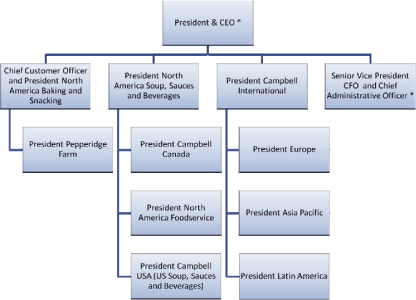
* Represents the CODM
| In determining our operating segments, we considered the information provided in the CODM package and the manner in which performance is evaluated. Since the CODM package |
3
Mr. Mark Shannon
U.S. Securities and Exchange Commission
March 11, 2011
U.S. Securities and Exchange Commission
March 11, 2011
| includes multiple levels of information, we considered the provisions in ASC 280-10-50-6 in our assessment. |
| The CODM package includes net sales and EBIT information for businesses managed by executives at the levels depicted on the chart under the direct reports of the CEO -- i.e., Pepperidge Farm, Canada, North America Foodservice, U.S. Soup, Sauces and Beverages, Europe, Asia Pacific and Latin America. In addition, the results of the Arnott’s biscuit business within Asia Pacific are separately identified in the CODM package because the components in this region contain dissimilar businesses: soup, sauces and beverages; and baked products. The CODM views the performance of Asia Pacific biscuits separately from Asia Pacific soup, sauces and beverages, and therefore, these components represent operating segments. Consequently, the eight operating segments are Pepperidge Farm, Canada, North America Foodservice, U.S. Soup, Sauces and Beverages, Europe, Latin America, Asia Pacific Biscuits and Asia Pacific Soup, Sauces and Beverages. | |||
| Supplemental information is also provided in the CODM package for net sales and allocated EBIT for the soup, sauces and beverages product lines within our U.S. Soup, Sauces and Beverages segment, and for our investment in emerging markets (Russia and China). Our Russia and China operations, which are not significant, are managed as part of Europe and Asia Pacific, respectively, and are therefore included within those operating segments. Supplemental information regarding the company’s businesses in Russia and China was historically included in the CODM package to track the investment in these regions as the company entered those markets. Although this supplemental information is included in the CODM package, it is not the basis for the allocation of resources. Determination of annual earnings targets and capital spending budgets, the primary method of allocating resources, occurs at the levels identified below the direct reports of the CEO with Asia Pacific separated by business. The CODM package is distributed not only to the CODM but also to the corporate leadership team, which represents various levels of management and functions below the CODM and is used for other purposes internally. | |||
| Reportable Segments |
| § | U.S. Soup, Sauces and Beverages. Because supplemental information on U.S. Soup, Sauces and Beverages is provided in the CODM package, we evaluated the guidance in ASC 280–10–50–6 through 50–8 to determine the reportable segment and operating segment. The following factors were considered: |
| – | The CODM determines performance objectives and allocation of resources at the U.S. Soup, Sauces and Beverages level. Annual operating plan objectives and targets are developed in total for U.S. Soup, Sauces and Beverages. Management of U.S. Soup, Sauces and Beverages is measured on the performance of the total business, not product lines. The CODM regularly interacts with the President-North America Soup, Sauces and Beverages (the segment manager) about the operations and results of U.S. Soup, Sauces and Beverages segment. Financial information is provided bi-monthly to the company’s Board of Directors for total U.S. Soup, Sauces and Beverages. | ||
| – | Soup, sauce, and beverage product lines comprise an integrated business. The products are primarily produced at four thermal processing plants in the U.S. and the supply chain is managed on an integrated basis. There are no supply chain metrics or targets below the total business level. Assets and resources (order processing, |
4
Mr. Mark Shannon
U.S. Securities and Exchange Commission
March 11, 2011
U.S. Securities and Exchange Commission
March 11, 2011
| production planning, warehousing) are integrated. The products are produced by a thermal production process and contain many similar raw materials, such as tomato paste and vegetables. Products are sold and distributed to customers (retail grocers and mass merchandisers) on a combined basis. Products are shipped and invoiced together. Quality assurance is managed on an integrated basis. |
| Based on the foregoing factors, the U.S. Soup, Sauces and Beverages business represents an operating and a reportable segment. | |||
| § | Baking and Snacking. The Baking and Snacking reportable segment is comprised of the Pepperidge Farm operating segment and the Arnott’s operating segment. The following factors were considered in determining that aggregation is appropriate under ASC 280-10-50-11: |
| – | Both businesses manufacture and sell similar products such as cookies, crackers and other baked products. The products are manufactured in a similar manner using a baked oven process and similar ingredients, such as flours, oils, cocoa and dairy products. Some products are marketed under both brand names (i.e., co-branded under both Arnott’s and Pepperidge Farm trademarks). Products are marketed and sold to similar types of retail customers (grocers and mass merchandisers). Product development work is performed on a combined basis for these businesses. The businesses face similar exposure to commodity costs. | ||
| – | The businesses have similar economic characteristics, as measured by gross margin performance. The relative difference in gross margins has been, and is expected to be, under 10%. In 2010 gross margins were **** and ****, a relative difference of approximately 5%, for the businesses. The three-year historical average was **** and ****. These businesses operate in similar competitive environments, including a common international competitor, and have similar long-term economic expectations. |
| § | International Soup, Sauces and Beverages. The International Soup, Sauces and Beverages segment, which represents less than 25% of total company sales, essentially represents “other” and aggregates the businesses in Canada, Asia Pacific, Europe and Latin America/Mexico. The following factors were considered in determining that aggregation is appropriate under ASC 280-10-50-11: |
| – | As in the U.S. business, the nature of products in the International businesses is similar – various soup, sauces and beverages. The types of customer (retail grocers and mass merchandisers), distribution and manufacturing processes are also similar. Products are primarily manufactured using a thermal production process. Products are sold through either in-house sales teams or independent brokers. | ||
| – | The businesses have similar economic characteristics, as measured by gross margin performance. The relative difference in gross margins was less than 10% in 2010, ranging from **** to ****. However, we note that the relative difference in gross margin has exceeded this level on a three-year historical average basis, resulting in a |
| * | Amounts omitted from response pursuant to a confidential treatment request under 17 C.F.R. § 200.83. | |
5
Mr. Mark Shannon
U.S. Securities and Exchange Commission
March 11, 2011
U.S. Securities and Exchange Commission
March 11, 2011
| 13% relative range (**** – ****), due to the higher gross margin in our Canadian business, which represents approximately 6% of net sales. The Canadian business does not meet quantitative thresholds for separate reporting. |
| § | North America Foodservice. The North America Foodservice business, which predominantly consists of soup, sauces and beverage products sold through foodservice channels, is reported separately from the retail segment as this business does not meet the economic and other factors for aggregation with other businesses. |
| The company believes that its segment disclosures provide investors and users of financial statements with the most meaningful information about the types of business activities in which it is engaged and the different economic environments in which it operates to understand the company’s performance, assess prospects for future cash flows and make informed decisions about the company as a whole. | |||
| We are mindful of the obligation to continuously reassess segment reporting, especially in light of the transition of the Chief Executive Officer at the end of this fiscal year and other management changes in fiscal 2011. We will monitor and revise our segment reporting, if necessary. |
| Note 6: Business and Geographic Segment Information, page 43 |
| 4. | You state in your response to prior comment seven that you believe the additional enterprise-wide disclosures required by ASC 280-10-50-40 are not required because you manage and report based on products that are similar in nature. However, we note your website and your annual report to shareholders appear to distinguish between product lines as discussed in prior comment seven. In this regard, we note that the groups of products specified in your product portfolio appear to be sufficiently dissimilar such that disclosure of the underlying revenues may be required under ASC 280-10-50-40. Such dissimilarities may include the contents of the products, or the way the products are marketed, portrayed, or branded. For example, we note your statements within your Form 10-K that the company’s overarching business strategy is to drive profitable growth by focusing on three large and growing categories – simple meals, baked snacks, and healthy beverages. You also provide in your MD&A, or broadly refer to the existence of, quantitative information for sales related to broths, sauces, condensed soups, ready-to-serve soups, and different types of beverages, which may be an indication of the existence of dissimilarities between these groups of products. Based on the preceding, please provide us an analysis that more fully addresses your facts and circumstances, including any product groups within your other segments. In the alternative, provide the disclosures required by the accounting literature, including the information that would have been included in your Form 10-K, in your upcoming Form 10-Q. | ||
| We provide certain quantification of sales performance within our largest segment, U.S. Soup, Sauces and Beverages, because we believe this may assist investors and analysts in better understanding the performance of this segment, not because the products are dissimilar. We acknowledge that in certain communications, we also provide a consumer-oriented view of the |
| * | Amounts omitted from response pursuant to a confidential treatment request under 17 C.F.R. § 200.83. | |
6
Mr. Mark Shannon
U.S. Securities and Exchange Commission
March 11, 2011
U.S. Securities and Exchange Commission
March 11, 2011
categories in which we compete. As additional information for
investors, in our Form 10-Q for the fiscal quarter ended January 30, 2011, we provided the
following information:
| Three Months Ended | Six Months Ended | |||||||||||||||
| January 30, | January 31, | January 30, | January 31, | |||||||||||||
| 2011 | 2010 | 2011 | 2010 | |||||||||||||
Net sales |
||||||||||||||||
Simple Meals |
$ | 1,335 | $ | 1,397 | $ | 2,666 | $ | 2,796 | ||||||||
Baked Snacks |
566 | 530 | 1,154 | 1,102 | ||||||||||||
Beverages |
226 | 226 | 479 | 458 | ||||||||||||
Total |
$ | 2,127 | $ | 2,153 | $ | 4,299 | $ | 4,356 | ||||||||
| Fiscal Year Ended | ||||||||||||
| August 1, | August 2, | August 3, | ||||||||||
| 2010 | 2009 | 2008 | ||||||||||
Net sales |
||||||||||||
Simple Meals |
$ 4,594 | $ 4,674 | $ 4,815 | |||||||||
Baked Snacks |
2,129 | 1,995 | 2,200 | |||||||||
Beverages |
953 | 917 | 983 | |||||||||
Total |
$ | 7,676 | $ | 7,586 | $ | 7,998 | ||||||
| Simple meals include condensed and ready-to-serve soups, broths and sauces. Baked snacks include cookies, crackers, biscuits and other baked products. | |||
| We will also provide this disclosure in future filings. |
| Item 15: Exhibits and Financial Statement Schedules, page 78 |
| 5. | We note your belief in response to prior comment nine that the accounts receivable allowances are not material. It is not clear, however, how you considered the materiality of the other components of Schedule II, namely the additions and deductions. Please provide us these amounts as part of your materiality assessment. |
7
Mr. Mark Shannon
U.S. Securities and Exchange Commission
March 11, 2011
U.S. Securities and Exchange Commission
March 11, 2011
| (millions) | ||||||||||||||||||||
| Charged to | ||||||||||||||||||||
| Balance at | (Reduction in) | Balance at | ||||||||||||||||||
| Beginning of Period | Costs and Expenses | Divestitures | Deductions | End of Period | ||||||||||||||||
Fiscal Year Ended August 1, 2010 |
||||||||||||||||||||
Cash discount |
$ | 5 | 116 | - | (116 | ) | $ | 5 | ||||||||||||
Bad debt reserve |
$ | 3 | 2 | - | (1 | ) | $ | 4 | ||||||||||||
Return reserve (a) |
$ | 11 | (3 | ) | - | - | $ | 8 | ||||||||||||
Total Accounts Receivable Allowances |
$ | 19 | 115 | - | (117 | ) | $ | 17 | ||||||||||||
Fiscal Year Ended August 2, 2009 |
||||||||||||||||||||
Cash discount |
$ | 5 | 116 | - | (116 | ) | $ | 5 | ||||||||||||
Bad debt reserve |
$ | 5 | 1 | - | (3 | ) | $ | 3 | ||||||||||||
Return reserve (a) |
$ | 11 | - | - | - | $ | 11 | |||||||||||||
Total Accounts Receivable Allowances |
$ | 21 | 117 | - | (119 | ) | $ | 19 | ||||||||||||
Fiscal Year Ended August 3, 2008 |
||||||||||||||||||||
Cash discount |
$ | 5 | 113 | - | (113 | ) | $ | 5 | ||||||||||||
Bad debt reserve |
$ | 8 | - | (2 | ) | (1 | ) | $ | 5 | |||||||||||
Return reserve (a) |
$ | 10 | 1 | - | - | $ | 11 | |||||||||||||
Total Accounts Receivable Allowances |
$ | 23 | 114 | (2 | ) | (114 | ) | $ | 21 | |||||||||||
| (a) | The return reserve is evaluated quarterly and adjusted accordingly. During each period, returns are charged to the statement of earnings as incurred. Actual returns were approximately $130 in 2010, and $140 in 2009 and 2008, or less than 2% of net sales, which is not considered material. |
| Cash discounts are offered typically for payments within 10 or 15 days and therefore are resolved shortly after a period end. The allowance related to cash discounts is not considered material to the accounts receivable balance. Actual experience does not vary significantly from estimates, as most customers elect the allowance. These discounts represent approximately 1.5% of net sales, which are not considered material. | |||
| Although we believe the activity does not provide financial statement users with material information, we will assess the information as of July 31, 2011 for potential inclusion in the Form 10-K. |
Form 10-Q for Fiscal Quarter Ended October 31, 2010
Sales, page 16
| 6. | We note your response to prior comment ten, but it remains unclear to us the reasons for the timing and amount of promotional spending related to a specific product group. To assist us in evaluating your response to prior comment ten, for each of the below references, please identify and briefly describe for us the primary reason it was necessary to increase or decrease promotional spending, and the timing within the quarter when the decision occurred. As part of your response, please analyze whether additional disclosure for your promotional spending decisions would be appropriate under Item 303 of Regulation S-K. | ||
| As described in our previous response, our strategies for promotional spending are developed in the context of comprehensive business plans. Promotional spending is one of many marketing tools that are used to influence consumer purchase decisions, usually by discounted shelf prices, store advertisements such as circulars, or specific display activity in the store. Promotion programs are geared toward creating an immediate boost in sales volume in response to a substantive offer in the promotion, such as a lower price or a store display. In contrast to advertising programs that are designed to build brand image or brand awareness, sales promotions are usually tied directly to the act of buying the product being promoted. As |
8
Mr. Mark Shannon
U.S. Securities and Exchange Commission
March 11, 2011
U.S. Securities and Exchange Commission
March 11, 2011
| a result, promotions typically provide a direct and positive motivation to consumers to purchase the products being promoted. | |||
| Our promotional strategies, including the timing and amount of promotional spending, are developed annually for specific brands or product lines, taking into account brand objectives, anticipated competitive activity, cost inflation forecasts, price differentials to substitutable products, general economic conditions impacting consumer behavior, and the estimated volume impact of the promotional programs, among other factors. Based on these strategies, promotional funds are committed. The effectiveness of these investments can vary as a result of competitive pricing and activity, retail execution and consumer response in the marketplace. Consequently, the impact of the higher promotional spending, while always negative with respect to realized price per unit, is variable with respect to its total impact on revenue. | |||
| We work with our retail customers to agree on the promotional calendar and specific activities by brand. This planning generally takes place months ahead of the actual events to ensure proper execution (e.g., suggested promotional pricing, shelving, advertising, and location of displays). These strategies are implemented through the planning and execution of trade merchandising events with our retail customers over the fiscal year. Details of these promotional plans and the marketing insights that drive their development are competitively-sensitive and are treated as highly confidential because of the risk of pre-emptive promotional activity by competitors in the marketplace that would impact our own plans to drive growth for the brand. | |||
| Our retail customers have regular shelf prices for our products that are determined by each retailer based on its business needs and competitive situation. As an example of a specific promotional event, Campbell might offer a retail customer the opportunity to run a trade merchandising event during a specific calendar period. In connection with the promotional event, Campbell would provide product discounts to the retailer for agreeing to offer its products at a reduced price for a specific length of time, and may also include agreements related to the retailer’s advertising and level/location of product displays. A particular promotion may be motivated, for example, by a desire to pass along a discount to a particularly price sensitive consumer group in a challenging economic area, by a strategy to enhance brand exposure and encourage trial with target consumers, or by a desire to lower prices to meet a competitor’s promotional prices in a particular period. Promotions tend to build store traffic and create incentives for consumers to notice and hopefully decide to purchase a particular product. | |||
| We maintain comprehensive trade management systems to monitor and control thousands of trade merchandising events over a fiscal year. For each of our trade events, we recognize as promotional spending the contra-revenue impact of these discounts provided to retailers reflecting both the depth of the discount on a per unit basis and the volume sold during the time period of the event. In our disclosures, we quantify the revenue impact of changes in our promotional spending. |
| – | Page 21 of the Form 10-Q for Fiscal Quarter Ended November 1, 2009: In the bakery business, the sales increase from the acquisition was mostly offset by increased promotional spending. |
9
Mr. Mark Shannon
U.S. Securities and Exchange Commission
March 11, 2011
U.S. Securities and Exchange Commission
March 11, 2011
| Driven by a weak economy and increased price competition throughout the category, especially for premium-priced bakery products, the trade strategy for bakery products developed at the beginning of the fiscal year 2010 focused on offering additional discounts on our bakery products to retail customers to stimulate consumer purchases. Specifically, in connection with merchandising events to promote our Farmhouse brand bread products, and a “Buy one Get one Free” merchandising event for Pepperidge Farm Swirl bread, we increased our promotional spending, which had a negative impact on sales. | |||
| – | Page 23 of the Form 10-Q for Fiscal Quarter Ended January 31, 2010: Sales of ready-to-serve soups decreased 18%. Sales of both canned and microwavable soups declined due to lower promotional spending and intense competitive pressure in the broader simple meals category. | ||
| During the previous fiscal year, in the second quarter ended February 1, 2009, we participated in a major merchandising event with one of our primary customers in which we offered discounts on our Campbell’s Chunky canned ready-to-serve soup products. In fiscal year 2010, we participated in the same merchandising event during the previous quarter which ended November 1, 2009. As a result, our promotional spending level was down in the quarter that ended January 31, 2010 as compared to the year-ago period, reflecting the change in the timing of this promotion. During this same period, retailers were offering many alternative simple meals products at reduced prices, which had a negative impact on the sales volumes of our products. Reflecting our lower level of promotional activity and the increased activity of our competitors, and the related impact on volume, sales were negatively impacted in the quarter. | |||
| In addition, as part of the annual planning process for our microwavable soup products, we made the decision to reduce the level of promotional activity on these products, as consumers have been less willing to pay a premium for these products in the current economic environment. | |||
| – | Page 22 of the Form 10-Q for Fiscal Quarter Ended May 2, 2010: (i) Sales of Campbell’s condensed soups declined 1% with declines in cooking and eating varieties, as increased promotional spending was only partially offset by volume gains. (ii) Sales of ready-to-serve soups increased 4%. Volume gains in Campbell’s Chunky and Select Harvest canned soups were partially offset by increased promotional spending and declines in microwavable varieties. | ||
| Prior to and during the quarter, in response to an increased level of promotional activity across many competitive simple meal alternatives in the marketplace, we decided to increase our level of promotional spending on both condensed and ready-to-serve soups. With respect to condensed soups, examples include funding merchandising events in which retailers offered certain condensed soup products at $.50 per unit and also a “line sale” of our condensed soup products in which retailers offered 10 units for $10. For our ready-to-serve soup products, we offered discounts to certain retailers to promote our Campbell’s Chunky products at $1.25 per unit and our Select Harvest products at 10 units for $10. These represent higher promotional discount levels on both condensed and ready-to-serve soups compared to the year ago period, resulting in higher promotional spending. Although these promotions resulted in volume gains, the spending had a negative impact on sales. |
10
Mr. Mark Shannon
U.S. Securities and Exchange Commission
March 11, 2011
U.S. Securities and Exchange Commission
March 11, 2011
| – | Page 17 of the Form 10-Q for Fiscal Quarter Ended October 31, 2010: (i) Sales of Prego pasta sauce declined as higher promotional spending was only partly offset by volume gains. (ii) Sales at Pepperidge Farm were comparable to a year ago, as volume gains were offset by increased promotional spending. (iii) In International Soup, Sauces and Beverages, sales decreased 1% primarily due to currency as volume gains were offset by increased promotional spending. (iv) In Canada, sales increased due to currency and solid volume gains, partially offset by increased promotional spending. | ||
| As part of our annual 2011 planning process, the company decided to increase the promotional spending on Prego pasta sauces in order to be more competitive in the Italian sauce category, where competitive sauces were heavily price-promoted. In the first quarter execution of these plans, retailers ran discounts for trade merchandising events in which our products were promoted at 3 units for $5.00 (average retail price of $1.67) as compared to promotions in the prior-year period in which we offered discounts for promoted prices of 2 units for $4.00 (average retail price of $2.00). As a result of the higher per unit discount and an increase in the volume sold on promotion, promotional spending increased, resulting in a negative impact on sales. | |||
| As part of our annual 2011 planning process for the Pepperidge Farm business, we decided to increase our promotional spending behind our Goldfish snack cracker products. For example, we offered discounts to retailers to merchandise single-serve Goldfish products at $1.00 per unit, which were not offered in the prior year, and also to merchandise our larger size Goldfish products at a key retailer at $6.99 per unit for an 8-week period compared to a 4-week event in the prior year at $6.49 per unit. Reflecting the discounting associated with the execution of these events, promotional spending increased, which had a negative impact on sales. | |||
| Within our International Soup, Sauces, and Beverages segment, the decision was made during the fourth quarter of fiscal 2010 to increase the promotional spending across soup and beverage products sold by our Canadian business. In the Canadian marketplace, our products compete with a number of other simple meal product categories, including frozen pizza and frozen entrees, and retailers were offering these competing products at discounted prices. In order to remain price competitive with these other simple meal promotions, we offered additional discounts on our products. These additional discounts resulted in higher promotional spending and negatively impacted the sales of our business in Canada, as well as the International Soup, Sauces and Beverages reporting segment. |
| We believe that much of the information about the company’s promotional plans and strategies for particular products and the key consumer and marketplace insights that influence their development is proprietary to Campbell and that specific disclosure would put the company at a competitive disadvantage without adding any meaningful disclosure for investors. As indicated in our previous response, management also believes that any attempt to identify and quantify specific reasons for the results of promotional spending, beyond their effects on the Company’s financial results, would be speculative. | |||
| However, we note the Staff’s suggestion that additional clarification about the company’s promotional spending in a particular period may enhance investor understanding. In the Form 10-Q for the fiscal quarter ended January 30, 2011, we expanded the discussion of trade promotion. To the extent that material explanatory factors about the results of our |
11
Mr. Mark Shannon
U.S. Securities and Exchange Commission
March 11, 2011
U.S. Securities and Exchange Commission
March 11, 2011
| promotional spending are known to management and important to an understanding of our results, we will include such disclosures in future filings. |
* * * * *
As requested by the Staff, we acknowledge:
| • | the company is responsible for the adequacy and accuracy of the disclosure in its filings; | ||
| • | Staff comments or changes to disclosure in response to Staff comments do not foreclose the Commission from taking any action with respect to the filings; and | ||
| • | the company may not assert Staff comments as a defense in any proceeding initiated by the Commission or any person under the federal securities laws of the United States. |
| Sincerely, CAMPBELL SOUP COMPANY |
||||
| By: | /s/ B. Craig Owens | |||
| B. Craig Owens | ||||
| Senior Vice President — Chief Financial Officer and Chief Administrative Officer |
||||
| cc: | Douglas R. Conant Ellen O. Kaden Anthony P. DiSilvestro Michael Fay – Securities and Exchange Commission |
| Enclosure: | Exhibit A* |
* Exhibit A omitted from response pursuant to a confidential treatment request under 17
C.F.R. § 200.83.
12